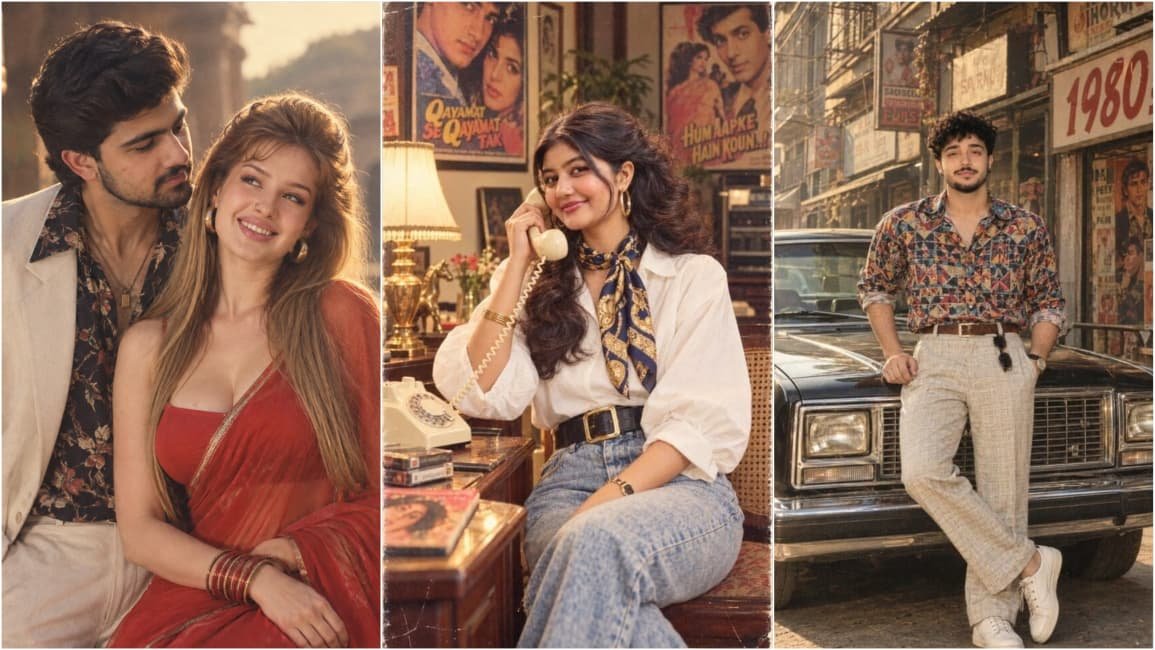
The 80s look is back in style, and thanks to AI image generators, it’s easier than ever to recreate that nostalgic vibe. The right Trending 80s Prompts can turn a normal modern photo into a realistic looking vintage photograph inspired by the 1980s.
With AI, you can make 80s-style images in infinite ways. There are classic fashion and old-school hairstyles, vintage cars, cassette players, CRT televisions, neon lights, and analog film effects.
80s Trending Prompts: What Are They ?
Trending 80s prompts are step-by-step instructions that tell an AI image generator how you want your photo to look. You can tell us about the clothing, background, lighting, camera style, colors and atmosphere rather than asking for a simple “80s photo.”
You could ask the AI to create a realistic 1980s portrait, using vintage clothing, 35mm film photography, natural skin texture, soft flash, subtle film grain and slightly faded colors, for example.
The more specifically you describe the scene the easier it will be for the AI to understand what you want.
Why Are 80s Photos Blowing Up?
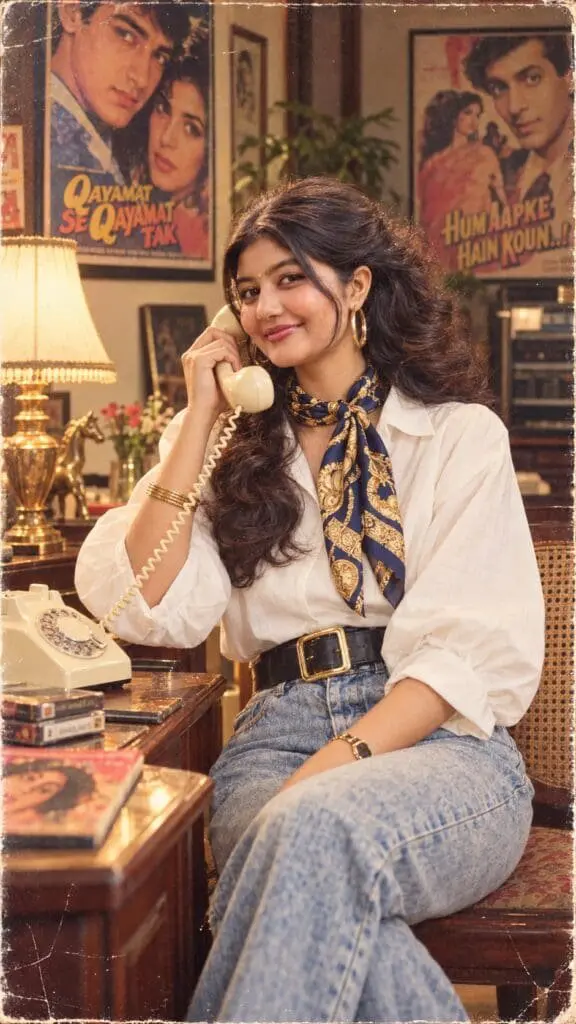
Use my uploaded photo as the face and identity reference. Keep my exact facial features and identity unchanged. Create a glamorous cinematic 1980s Bollywood-inspired indoor portrait. I am sitting beside a vintage cream-colored rotary telephone, holding the receiver near my ear. I am wearing a loose elegant white blouse with voluminous puff sleeves, high-waisted light-wash acid-washed jeans and a wide black belt with a large gold buckle. A luxurious navy-and-gold printed silk scarf is tied around my neck, large gold hoop earrings and vintage gold bangles. Big soft voluminous 80s wavy hair, expressive eyes, soft pink lips and elegant natural makeup. Warm vintage room with retro Bollywood movie posters, wooden furniture and a table lamp. Rich warm lighting, authentic analog film grain, faded edges, slight film scratches, nostalgic 1980s Indian cinema magazine aesthetic, cinematic composition, highly photorealistic. Ratio 9:16
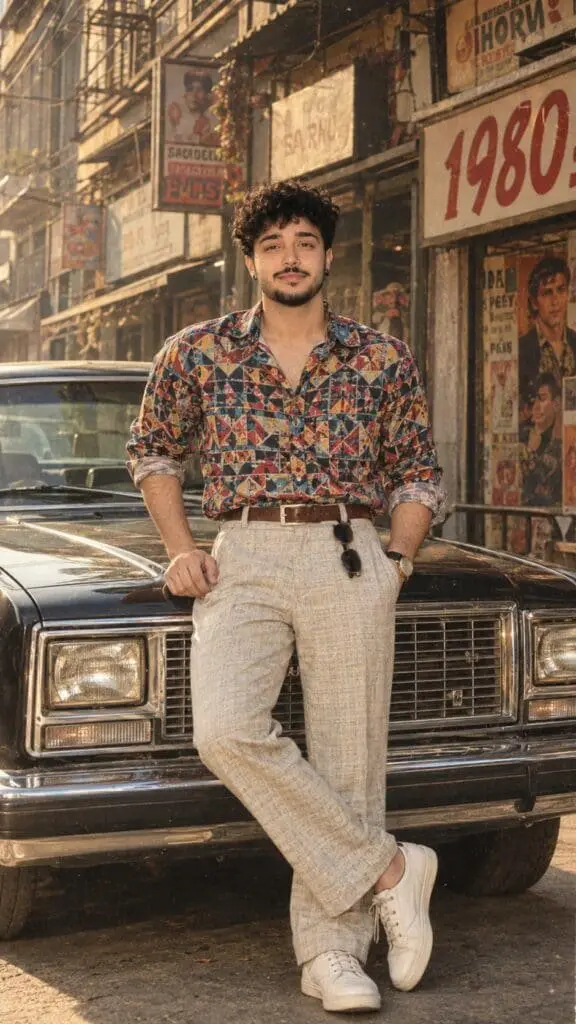
Create an ultra-realistic cinematic vintage street portrait using the reference image.
Preserve the subject’s natural facial appearance, facial structure, facial proportions, skin tone, eyes, nose, lips, beard, moustache, hairstyle, body proportions and overall identity as closely as possible. Do not beautify, reshape or artificially alter the face.
Recreate the overall composition of a stylish retro street-fashion photograph. Show a bearded man casually leaning against the front side of a classic black vintage car, with one hand resting near the car and the other relaxed near his pocket. Maintain a confident, relaxed and natural expression.
Keep the outfit similar to the reference: a colorful retro geometric-patterned button-up shirt with the sleeves rolled up, tucked into high-waisted light-colored patterned trousers, secured with a brown leather belt. Include a classic wristwatch and sunglasses hanging naturally from the belt area.
The car should look like an authentic classic black automobile from the 1970s–1980s era, with detailed chrome grille, rectangular headlights, realistic reflections, vintage bodywork and period-appropriate proportions.
Create a nostalgic 1980s-inspired urban street environment. Include retro storefronts, vintage posters, painted signs, old architecture, music or fashion shop elements and warm street details in the background. Add a large retro “1980s” visual sign in the environment while keeping background text naturally integrated into the scene.
Use warm golden-hour sunlight with cinematic side lighting, soft shadows, realistic highlights and subtle atmospheric haze. Add authentic vintage film grain, slightly faded tones, natural contrast, subtle film imperfections and a realistic analog-photography texture.
The image should feel like a premium editorial photograph inspired by classic 1980s Indian street fashion and vintage cinema aesthetics, while remaining photorealistic and modern in image quality.
Use realistic skin texture, individual beard and hair strands, detailed fabric texture, natural wrinkles in clothing, realistic car reflections and believable environmental depth.
Photography style: professional DSLR photography, 50mm lens, shallow depth of field, cinematic composition, realistic bokeh, high dynamic range, natural perspective and ultra-detailed photorealistic quality.
Composition: vertical 9:16, full-body portrait, subject and classic car clearly visible, balanced framing, natural standing pose.
Avoid plastic skin, excessive beauty filters, face reshaping, unrealistic beard, distorted hands, extra fingers, missing fingers, bad anatomy, duplicated limbs, warped car, incorrect vehicle proportions, unrealistic clothing, excessive saturation, artificial background, cartoon effects, low resolution, watermark, random text, unwanted logos and AI artifacts.
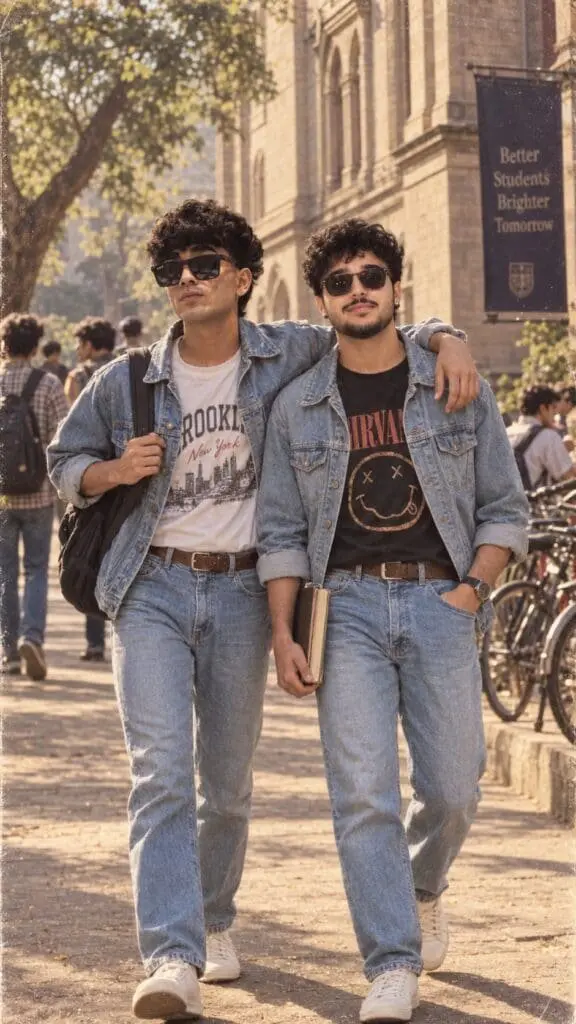
Create a highly photorealistic cinematic 1980s-inspired Indian retro photograph using the reference image for accurate facial identity.
Preserve both people’s exact facial identity, facial structure, natural skin tone, age, recognizable features and realistic body proportions. Do not replace, reshape, beautify or significantly alter their faces.
Create a nostalgic friendship portrait showing two young male friends walking casually together on a vintage college campus walkway.
The friend on the left is wearing a classic light-blue denim jacket over a white vintage graphic T-shirt, matching high-waisted blue denim jeans, a brown leather belt, retro dark sunglasses and white sneakers. His curly textured hairstyle should have an authentic 1980s-inspired appearance.
The friend on the right is wearing a light-blue denim jacket over a dark vintage rock-inspired graphic T-shirt, matching blue denim jeans, a brown leather belt, a classic wristwatch, retro sunglasses and white sneakers. Give him naturally curly, voluminous 1980s-inspired hair.
Keep the left friend’s arm naturally resting around the right friend’s shoulder, creating a genuine close-friends walking pose. Both subjects should have relaxed and confident expressions.
Set the scene on an old college campus or historic educational street with large stone architecture, vintage buildings, trees, bicycles and students in the background. Include subtle period-appropriate environmental details to make the scene feel like an authentic 1980s photograph.
Use warm late-afternoon sunlight with soft shadows, natural highlights and gentle atmospheric haze. Create a nostalgic analog-film appearance with slightly faded colors, subtle film grain, realistic photographic texture and warm vintage tones.
Maintain realistic denim fabric texture, natural clothing folds, detailed hair strands, realistic skin texture, sunglasses reflections, watch details, bicycle details and architectural textures.
The final image should look like an authentic 1980s Bollywood-inspired friendship photograph captured on an analog film camera, not a modern digital illustration.
Use natural depth of field with the two friends remaining sharp while the background has realistic cinematic softness.
Maintain believable anatomy, natural walking positions, realistic hands and fingers, accurate legs and feet, and proper body proportions for both subjects.
Use a vertical 9:16 composition suitable for Instagram Reels, Stories and mobile wallpapers.
Avoid face distortion, identity changes, artificial faces, excessive beauty filters, plastic skin, cartoon effects, anime style, distorted hands, extra fingers, missing fingers, duplicated limbs, bad anatomy, unnatural walking poses, warped buildings, distorted bicycles, unrealistic clothing, excessive saturation, modern futuristic objects, blurry faces, low resolution, watermark, unwanted text and AI artifacts.
Nostalgic content is a big hit on social media because it creates an emotional bond with viewers. The 80s had its own visual style that was easily recognizable.
Vintage denim jackets, bright-colored outfits, classic cars, old TVs, arcade machines, cassette players and analog cameras instantly give an image the feeling of being from a different decade.
Create a cinematic 9:16 vertical commercial using my provided photo as the identity reference for the main male character. Preserve my exact facial identity, facial structure, skin tone, hairstyle characteristics, body proportions and recognizable appearance throughout the entire video. Do not morph my face or introduce a different person. Recreate the visual language, shot progression, camera choreography and cinematic feeling of the reference video, but replace the original actor with me. STYLE: Premium Indian cinematic commercial, nostalgic late-1970s/1980s-inspired Indian action-film aesthetic, warm dusty color palette, golden sunlight, subtle film grain, realistic skin texture, atmospheric dust, practical lighting, shallow depth of field, anamorphic-style highlights, natural motion blur, rich contrast, slightly faded film colors, sophisticated production design. It should feel like a real expensive film shoot, NOT AI-generated. WARDROBE: Dress me in an authentic retro Indian hero outfit inspired by the reference: off-white/cream traditional shirt or kurta with a strong deep-red scarf/stole, slightly loose vintage silhouette, period-appropriate styling. Add dark aviator sunglasses in the later hero shots. Keep the wardrobe consistent between shots. MOTORCYCLE: Use a classic vintage Indian motorcycle resembling the motorcycle in the reference. Chrome details, round headlamp, analog mechanical components and period styling. Motorcycle must remain physically realistic and consistent across shots. SHOT-BY-SHOT SEQUENCE: SHOT 1 — 0:00–0:01: Extreme macro close-up of the motorcycle. Show the rider’s cream/white sneaker resting on the motorcycle footrest and detailed chrome/black mechanical components. Camera is extremely close to the bike, low angle, shallow depth of field. Warm sunlight glints off chrome. Subtle vibration from the running motorcycle. Slow, deliberate cinematic camera movement. SHOT 2 — 0:01–0:03: Extreme close-up of my right hand gripping and operating the motorcycle throttle/handlebar. Show realistic hand movement, mechanical details and subtle vibration. Camera tracks alongside the hand with a very shallow depth of field. Warm highlights and deep shadows. Make the motorcycle feel powerful and tactile. SHOT 3 — 0:03–0:04.8: Cut to a frontal low-angle shot of the motorcycle approaching camera. I am riding directly toward the camera. The round headlight dominates the foreground, handlebars visible, my upper body behind it. Camera is positioned very low near road level. The motorcycle moves naturally toward the lens. SHOT 4 — 0:04.8–0:07.4: Continue the frontal motorcycle hero shot but gradually reveal my face and upper body. I ride confidently toward camera through an old Indian market street. Dust particles float through the sunlight. Background contains authentic old storefronts, faded Hindi signage, weathered walls, pedestrians and period Indian street details. Camera subtly pulls backward while maintaining cinematic framing. SHOT 5 — 0:07.4–0:09.8: Wider tracking shot. I ride the motorcycle through a busy old Indian bazaar. Camera moves laterally/backward with the motorcycle. Pedestrians naturally react and move around me. Traditional clothing, colorful shops, dusty street atmosphere, authentic Indian architecture. Keep me sharply recognizable while the background has natural cinematic motion blur. SHOT 6 — 0:09.8–0:12.7: Cut to a street-side shop/counter. I arrive and stop at a rustic old-fashioned Indian shop. The camera tracks toward me as I lean forward slightly from the motorcycle. Behind the counter are rows of colorful glass bottles and vintage product packaging. Several background characters look toward me naturally. SHOT 7 — 0:12.7–0:14.8: Medium close-up hero shot. I lean toward the counter with a confident, charismatic expression. Camera slowly pushes in. Warm golden sunlight passes through the dusty atmosphere behind me. Background people remain softly out of focus. My face must remain identical to the supplied photo. SHOT 8 — 0:14.8–0:15.7: Tighter dramatic close-up. I pick up a glass bottle from the counter and bring it toward my mouth. Keep the motion smooth and deliberate. Strong golden rim light around my hair and shoulders. Retro cinematic lens flare. SHOT 9 — 0:15.7–0:20.8: Hero drinking shot. I drink directly from the glass bottle while wearing dark aviator sunglasses. Camera slowly pushes in from a medium close-up to a tighter portrait. The setting transitions visually from the market to an open golden-hour environment while maintaining continuity. Warm sunset behind me, orange-gold backlight, atmospheric haze and beautiful lens flare. My expression is confident and effortless. SHOT 10 — 0:20.8–0:25.1: Final wide cinematic shot. Cut to a huge open rural landscape at sunset. I ride the motorcycle away from the camera into the distance. Camera is positioned far behind and slightly low, creating a heroic silhouette. The sun is directly ahead/near the horizon, producing strong golden backlight and long shadows. Dust trails naturally behind the motorcycle. I gradually become smaller in frame while riding toward the glowing horizon. CAMERA LANGUAGE: Use professional cinema-camera movement throughout: macro lens for detail shots, low-angle tracking, controlled dolly push-ins, smooth backward tracking shots, lateral tracking, shallow depth of field and wide environmental establishing shots. Camera movement should feel intentional and physically realistic. No random camera shaking. EDITING: Fast but elegant commercial editing. Hard cinematic cuts between motorcycle details and hero shots. Maintain the approximate timing and rhythm of the reference. Use natural motion continuity between shots. No flashy transitions, no artificial effects, no excessive slow motion. LIGHTING: Warm late-afternoon/golden-hour sunlight. Strong backlight and rim light, dusty atmospheric haze, practical shop lighting, realistic shadows, subtle anamorphic lens flare. Maintain consistent warm cinematic exposure. COLOR: Vintage Indian cinema-inspired warm amber, cream, muted reds and earthy browns. Slightly faded analog film colors with subtle 35mm grain. Premium commercial finish, realistic skin tones. IDENTITY CONSISTENCY — CRITICAL: The person must remain ME throughout the entire video. Use my supplied photo as the primary facial/identity reference. Preserve my exact face, eyes, nose, jawline, facial proportions, skin tone and recognizable features. Do not beautify, age, de-age, reshape or replace my face. Maintain identity consistency across every cut, angle and lighting condition. REALISM: Photorealistic live-action footage. Realistic motorcycle physics, natural hand movement, realistic cloth movement, authentic human expressions, believable pedestrians and physically accurate shadows/reflections. Avoid warped hands, extra fingers, duplicated people, distorted motorcycle parts, floating objects, plastic skin, cartoon appearance or AI artifacts. The final result should look like a high-budget Indian cinematic advertisement starring me, faithfully recreating the reference video’s visual choreography while using my face and identity.
Hero <<>> Car <<>> Create a 20-second vertical 9:16 premium Indian cinematic fashion film set entirely in authentic Bombay, India during the early-to-mid 1980s. This must feel like a genuine scene photographed on location in Bombay in the 1980s, not a modern Mumbai location with a vintage color filter applied. The main male character is the hero and visual anchor of the entire film. Use the provided character image as the primary identity reference. Preserve his exact facial identity, facial structure, skin tone, beard, hairstyle, body proportions and recognizable appearance throughout the entire sequence. Do not beautify his face, do not alter his facial structure, do not make his skin unnaturally smooth, and do not turn him into a generic Bollywood actor. Keep subtle natural skin texture, pores and realistic facial imperfections. The hero must remain clearly visible, recognizable and visually important throughout almost every shot. Keep him centered or very close to the center of the composition whenever he is present. Do not crop his head, face or body awkwardly. Do not let background characters or environmental details dominate the frame. The environment should frame and enhance the hero. CORE VISUAL FEEL: A sophisticated nostalgic 1980s Bombay action-film and fashion-commercial aesthetic. Think of a real expensive Indian cinema production photographed on 35mm film during a warm late afternoon in Bombay. The entire world must have one unified visual identity: warm amber sunlight, muted reds, dusty browns, faded mustard, cream, restrained teal, deep natural blacks and slightly faded blue tones. Warm vintage Indian cinema color grading, subtle analog film grain, gentle halation around highlights, soft highlight rolloff, mild atmospheric haze, natural contrast and realistic skin tones. Do not make the image overly orange. Do not make it look like a modern Instagram vintage preset. The warmth should come from actual golden sunlight, aged film stock and Bombay atmospheric haze. The image should have the organic softness and imperfections of real 35mm Indian cinema: subtle grain, slight exposure variation, natural lens flare, gentle highlight bloom, realistic motion blur, mild optical softness and naturally imperfect focus transitions. No CGI appearance. No plastic skin. No hyper-clean digital image. No excessive HDR. No artificial teal-orange blockbuster grade. No oversaturation. No crushed blacks. No excessive sharpening. 1980s BOMBAY STREET WORLD: Bombay must be unmistakable. The streets are dense, humid, dusty and alive. Old colonial and Art Deco buildings line the roads, with weathered plaster, aged stone, faded painted walls, balconies, old shutters, narrow shopfronts, vintage awnings and hand-painted commercial signs. The streets contain period-correct Bombay traffic: classic Premier Padmini taxis, old Ambassador cars, vintage buses, scooters, motorcycles, bicycles, delivery vehicles and pedestrians moving naturally through traffic. Include authentic red-and-cream BEST double-decker buses where appropriate. Pedestrians must look like real people from 1980s Bombay. Men wear tucked-in shirts, loose trousers, simple formal shirts, sweaters, vintage jackets and period-appropriate hairstyles. Women wear authentic 1980s Indian clothing such as saris, salwar suits and modest western clothing appropriate to the era. No contemporary streetwear, no smartphones, no modern sunglasses styles, no modern sneakers, no modern cars and no modern advertisements. The streets should feel crowded but believable, with traffic slowly flowing around the hero and the vintage convertible. Small details matter: old street vendors, newspaper sellers, tea stalls, pedestrians carrying shopping bags, bicycles passing through traffic, period motorcycles, dusty pavement, old road markings, weathered walls, vintage storefronts, hand-painted signs and warm sunlight reflecting from old vehicles. Avoid making Bombay look empty, futuristic, polished or artificially clean. MAIN CHARACTER: The hero wears the exact outfit shown in the supplied wardrobe reference: mustard-yellow vintage jacket with teal geometric stripe detailing, cream/off-white shirt, light-wash jeans, white vintage sneakers, silver pendant necklace, classic wristwatch and dark rectangular sunglasses. Keep the exact wardrobe, colors, accessories, hairstyle and beard consistent in every shot. His personality is effortless confidence. He does not overact. He does not constantly smile. His charm comes from posture, eye direction, walking rhythm and subtle facial expressions. He behaves like an iconic 1980s Indian cinema hero who is completely comfortable in his surroundings. AUTOMOBILE: Use the same glossy red vintage convertible from the supplied car reference throughout the film. It has authentic period proportions, polished chrome bumpers, chrome grille, rounded headlights, whitewall-style tires, cream interior and a beautifully restored but believable vintage finish. The car should not look like a modern car redesigned to look old. Keep the same red paint, chrome details, wheels, interior and body proportions in every shot. The open roof is important. Warm sunlight should enter the cabin naturally. SHOT FLOW: For the first two seconds, begin immediately with an intimate centered close-up of the hero sitting behind the wheel of the red vintage convertible while driving through a busy Bombay street. Do not begin with an establishing shot. His face occupies the central portion of the frame. Camera is positioned just inside the car, slightly below eye level, creating a subtle heroic perspective. His sunglasses are on. His face is sharp and naturally textured. The background contains moving Bombay traffic, old buildings and warm sunlight, but remains softly defocused. The open roof allows golden sunlight to illuminate his face and hair. He keeps one hand relaxed on the steering wheel. He looks naturally toward the road with quiet confidence. His expression is composed, charismatic and slightly mysterious. The camera makes a very slow controlled push toward his face while the car continues moving. The car vibrates subtly from the road. Hair and jacket move naturally in the airflow. For the next one second, cut to a tight centered detail of his wrist while he continues driving. His hand is naturally positioned on the steering wheel. The vintage watch becomes the sharpest element while his face remains clearly recognizable but softly blurred in the background. The camera catches realistic metallic reflections, natural skin texture and the texture of the steering wheel. Perform a very subtle rack focus from the watch toward his blurred face, reinforcing that he is still the hero of the frame. For the next two seconds, cut to a wider exterior three-quarter tracking shot of the same red convertible moving through a dense 1980s Bombay street. Keep the hero clearly visible and approximately centered within the windshield area rather than allowing the automobile to dominate the frame. Traffic naturally moves around him: Premier Padmini taxis, Ambassador cars, scooters, pedestrians and a period BEST bus in the distance. Old Bombay buildings surround the road. Camera tracks smoothly alongside the car at a low but not extreme angle. Warm sunlight reflects across the red paint and chrome. Dust and atmospheric haze create natural depth. Wheels rotate realistically. Background traffic produces gentle motion blur. For the next one and a half seconds, the convertible pulls toward the side of the street and stops outside an elegant old Bombay restaurant. Stay visually connected to the hero. Camera moves closer toward the driver’s side as he opens the door. The hero steps out of the car. The camera begins around the level of the car door and smoothly tilts upward with his body until he becomes a centered full-body hero composition. As he stands, he adjusts the mustard-yellow jacket naturally with both hands. He does not look into the camera. For the next one and a half seconds, follow him in a centered low-angle tracking shot as he walks toward the restaurant. Camera moves backward directly in front of him, keeping his body centered. His walking is relaxed and confident. His jacket moves naturally. His sunglasses remain on. The surrounding pedestrians notice him casually. Several young adult women and other pedestrians naturally glance toward him as he passes. Their reactions are subtle and realistic, never exaggerated or staged. The street continues to feel unmistakably 1980s Bombay around him. For the next one second, a large red-and-cream vintage BEST double-decker bus passes extremely close in front of the camera. The bus fills the entire frame with natural motion blur and physically wipes across the screen. The hero temporarily disappears only because the bus physically blocks the camera. This is a real-world foreground transition, not a digital transition. As the bus clears, reveal the interior of the restaurant. For the next two seconds, reveal a genuinely old Bombay restaurant from the 1980s. The restaurant must not look like a modern restaurant with retro furniture. Show aged wooden tables, dark polished wood, vintage ceiling fans, old glass windows, cream-colored walls, slightly weathered surfaces, period chairs, old tableware, tea glasses, newspapers and warm tungsten practical lights. Golden sunlight enters through large old windows and mixes naturally with the warm interior lighting. Dust particles are visible only where the sunlight catches them. Background customers wear authentic 1980s Bombay clothing and behave naturally: talking, reading newspapers, drinking tea and quietly moving through the restaurant. Keep the hero centered in the frame. He walks to a table, calmly adjusts his jacket, removes his sunglasses and places them beside a vintage newspaper. He sits down with effortless confidence. For the next one and a half seconds, stay centered on the hero at the table. He picks up the vintage newspaper and begins reading. The newspaper partially covers the lower part of his face, but his eyes and upper facial identity remain visible. The camera performs a slow cinematic push toward him. Warm window light illuminates one side of his face. His natural skin texture remains visible. No beauty retouching. For the next one second, move into a tighter shot where the newspaper occupies the foreground and his eyes become the visual target. Begin focus on the aged newspaper texture and printed columns, then slowly rack focus toward his eyes. He lowers the newspaper slightly. His sunglasses remain visible on the table. The expression remains calm, intelligent and quietly confident. For the next one and a half seconds, cut back outside. The hero exits the restaurant and walks toward his red vintage convertible. Keep him centered using a smooth frontal tracking shot. The Bombay street behind him is alive with period traffic and pedestrians. A newspaper seller passes in the background. A Premier Padmini taxi moves through the street. A vintage scooter crosses behind him. People naturally glance at the hero and his beautiful red convertible. A few people use period film cameras to photograph the car, creating the feeling that the automobile is an object of fascination. The hero never plays to the crowd. He simply continues walking. For the next one second, use the movement of a passing vintage vehicle as another physical foreground transition. A dark red vintage car passes extremely close across the lens, filling the frame with soft motion blur. The hero disappears only temporarily behind the vehicle. As it clears, reveal the hero driving again. For the next one and a half seconds, show an elegant centered driving shot along the Bombay waterfront. The red convertible moves beside the Arabian Sea. Camera tracks from the front passenger side while maintaining the hero as the central visual subject. He is clearly visible behind the wheel with sunglasses on. The open roof exposes him to the warm evening air. The sea, old waterfront architecture, period traffic and hazy Bombay skyline move naturally behind him. The golden sunlight creates warm reflections across the red bodywork. The image should feel like a frame from an expensive 1980s Indian movie. For the final two seconds, the convertible is parked beside the Arabian Sea during golden hour. The hero stands beside the car, centered in the frame. Camera begins as a medium-wide composition and performs an extremely slow cinematic push toward him. The Arabian Sea glows behind him. Warm sunlight creates a natural golden rim around his hair and shoulders. His mustard jacket catches the warm light while the teal detailing remains visible. A gentle sea breeze moves his jacket and hair. He initially looks toward the water. Then he slowly turns his head toward the camera. He makes direct eye contact. His expression changes naturally from calm and mysterious into a subtle confident smile. Do not exaggerate the smile. Hold the final centered hero composition for the last beat. The final frame must feel like an iconic 1980s Indian cinema poster brought to life, with the hero, red convertible and Arabian Sea forming one unforgettable composition. CONTINUITY: The same hero must remain the same person from the first frame to the final frame. The same mustard-yellow and teal jacket, cream shirt, jeans, sneakers, necklace, wristwatch, sunglasses, hairstyle and beard must remain consistent. The same red vintage convertible must remain consistent. The same 1980s Bombay visual world must exist throughout the entire film. Do not randomly change the weather, time period, architecture, wardrobe, automobile or character appearance. CAMERA: Use physically realistic professional cinema-camera movement. Centered hero close-ups, subtle push-ins, controlled frontal tracking, elegant lateral automobile tracking, motivated tilt-ups, shallow-focus detail shots, natural rack focus and slow final dolly movement. The camera should feel operated by a highly skilled cinematographer. Never use random drone movement, impossible camera movement, excessive handheld shake, artificial zooms or videogame-like camera motion. COLOR AND FILM: The color grade is critical. Warm vintage Indian cinema color palette with muted reds, dusty browns, faded mustard, cream, restrained teal, natural skin tones and deep but soft blacks. Golden amber sunlight should dominate the highlights. Keep reds slightly aged rather than digitally saturated. Keep mustard yellow rich but slightly faded. Keep teal subtle and period-appropriate. Keep skin natural and slightly warm without orange skin. Use subtle 35mm film grain throughout the entire video. Natural halation around bright sunlight. Gentle highlight bloom. Soft analog contrast. Slightly faded film colors. Natural atmospheric haze. Subtle optical imperfections. The final image must feel chemically photographed on vintage 35mm film rather than digitally color graded to imitate film. REALISM: Photorealistic live-action Indian cinema. Natural human anatomy. Natural hands and fingers. Realistic facial movement. Natural walking biomechanics. Realistic driving behavior. Realistic fabric physics. Natural hair movement. Authentic automobile reflections. Realistic chrome. Realistic glass reflections. Realistic sunlight. Realistic atmospheric depth. Natural crowd behavior. No plastic skin. No facial beautification. No artificial skin smoothing. No modern fashion. No modern vehicles. No modern architecture. No smartphones. No contemporary advertisements. No CGI appearance. No cartoon appearance. No futuristic elements. No excessive saturation. No excessive orange tint. No modern digital cinematic look. No excessive sharpening. No HDR. No artificial bokeh. No unstable backgrounds. No flickering. No duplicated people. No warped hands. No extra fingers. No distorted car geometry. No changing car design. No changing wardrobe. No facial morphing. No identity drift. No random expressions. No exaggerated acting. No digital transition effects. The finished video must feel as though a real Indian cinematographer went to Bombay in the 1980s, photographed this charismatic hero driving a beautiful vintage convertible through the city’s streets, entering an authentic Bombay restaurant, reading a newspaper and finally arriving beside the Arabian Sea at sunset. Every visual element, from the road and traffic to clothing, architecture, restaurant interiors, automobile, sunlight, film stock and color palette, must belong to the same authentic 1980s Bombay world.- no music AUDIO: No music, no background score, no soundtrack. Use only natural diegetic sound from the environment: vintage car engine, traffic, footsteps, street ambience, restaurant room tone, newspaper movement, sea breeze and subtle crowd sounds.
AI generated photos are also great for TikTok, Instagram Reels, Facebook and YouTube short videos. The original photo can be shown first and then the AI-generated 80s-version be revealed.
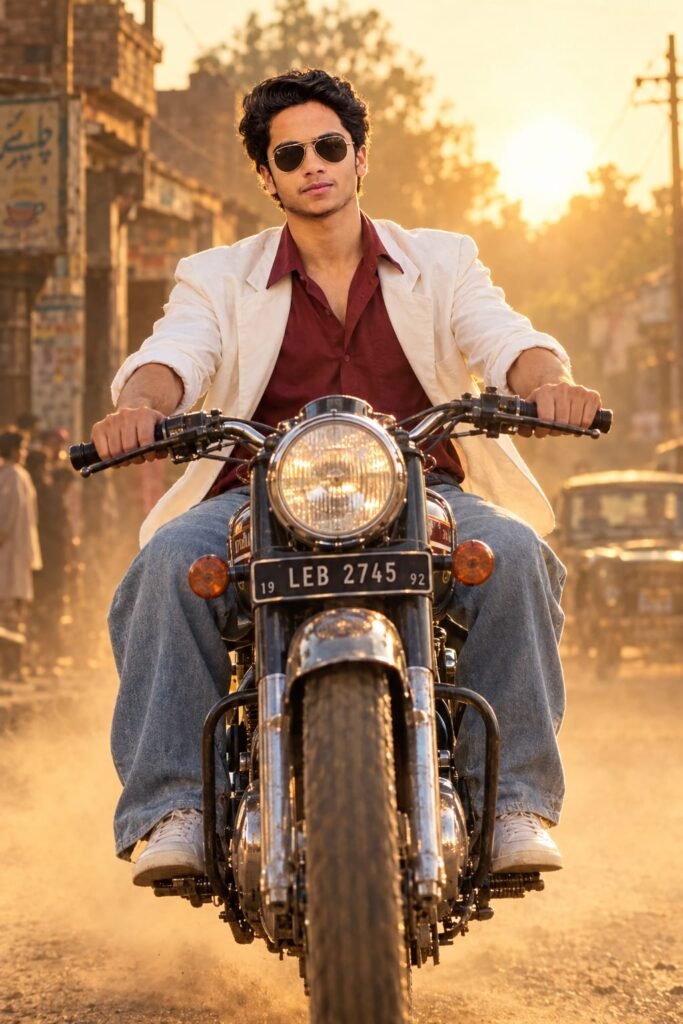
A cinematic, low-angle front shot of a stylish young South Asian man riding a vintage classic motorcycle directly towards the camera. He has voluminous wavy dark hair and black aviator sunglasses, wearing a maroon collared shirt under an unbuttoned white blazer with folded sleeves, light blue wide-leg jeans, and white sneakers. The motorcycle features a round chrome headlight and a front license plate. Set on a dusty town street with golden hour backlighting, atmospheric dust in the air, 90s Bollywood hero entry aesthetic, dramatic cinematic lighting, photorealistic, 8k resolution.
Best AI Prompt Ideas 80s
There are a lot of different ideas to try. Typical 80s portrait with vintage clothes, old indoor location, soft camera flash, realistic film grain and warm colors.
To create a retro couple photo, you can put two people in an authentic 1980s living room with an old television, vintage furniture and natural poses.
You can also create an 80s street fashion image with a classic car, denim outfit, sneakers, retro hairstyle and old city background.
Another popular idea is an 80s cinematic picture with neon lights, nite time streets, colorful reflections, vintage cars and realistic 35mm film photography.
Tips for Improved Results
When making an 80s AI photo, be specific about the environment, clothing, lighting, and photo style. Words like photorealistic, authentic 1980s photography, 35mm film, subtle film grain, natural skin texture, vintage colors, and analog camera can help you get a more convincing result.
If you are working from a reference photo, you can also instruct the AI to retain the person’s distinctive facial features and general appearance.
Conclusions
Trending 80s Prompts are a fun way to bring back the classic look of the 1980s. Vintage portraits, couple photos, street-fashion, cinematic scenes — AI is a playground for creative expression.
Experiment with different prompts, backgrounds, outfits and lighting styles to create your own unique retro photos and share them on your favorite social-media platforms.